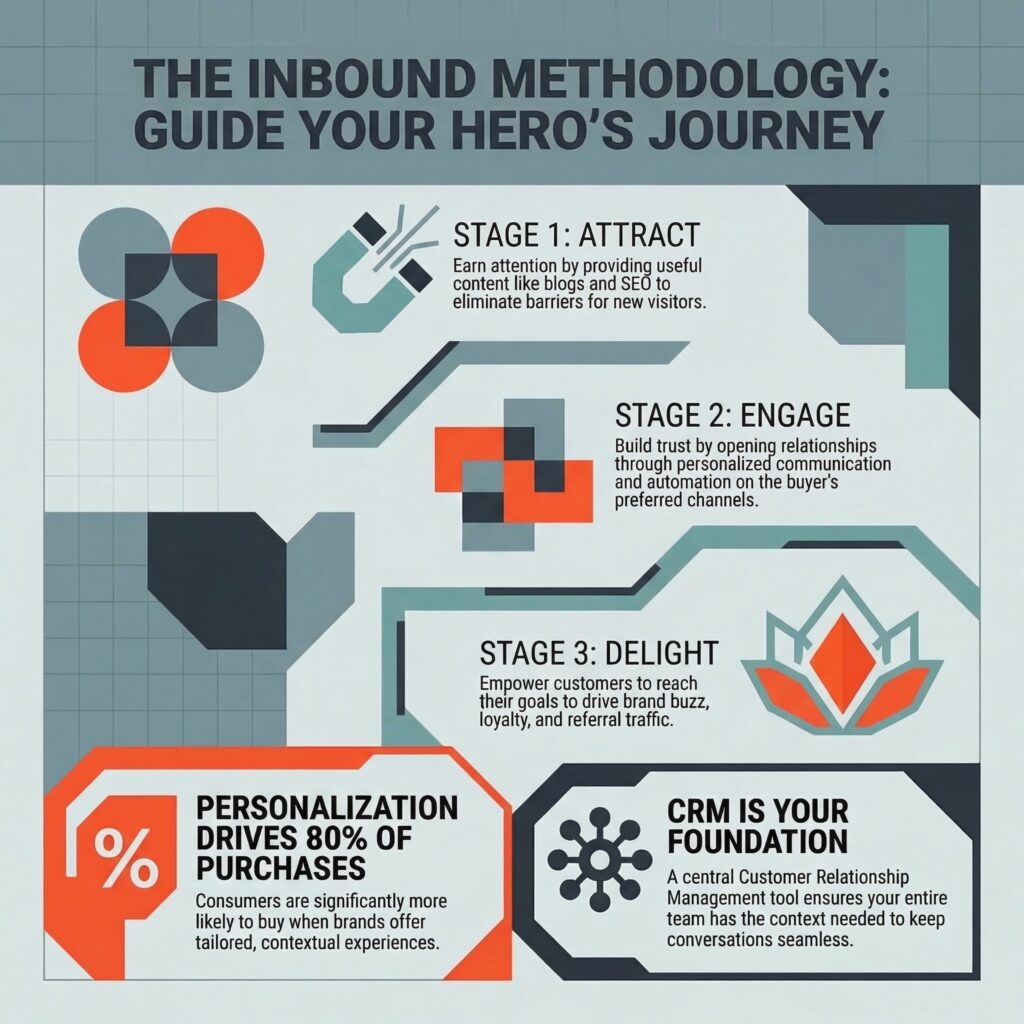
Welcome to today’s episode! If you have ever felt like marketing is just shouting into a void hoping someone listens, this transcript from HubSpot Academy offers a much-needed shift in perspective. It reframes the marketer not as a loud broadcaster, but as a “sage advisor” guiding a hero (your customer) through their journey.
Here is a summary of the core structure and key insights to help set the stage for our discussion:
The Inbound Strategy: Attract, Engage, Delight
The heart of the document is the Inbound Methodology, a three-stage flywheel designed to build lasting relationships rather than just closing one-off deals.
- Attract: Earning attention through high-value content like blogs, SEO, and social media rather than forcing it.
- Engage: Making it easy for leads to buy on their own timeline through personalization, email nurturing, and bots.
- Delight: Empowering customers to reach their goals, turning them into loyal promoters who drive referrals.
The Three Pillars of a Strong Foundation
Before launching campaigns, the document emphasizes that successful inbound marketing requires “guardrails” to keep the buyer at the center of the strategy:
- Buyer Personas: Researching the specific demographics and behaviors of your ideal customers so you attract the right traffic, not just any traffic.
- The Buyer’s Journey: Understanding the path from awareness of a problem to the final purchase decision.
- Personalization & Automation: Using data to tailor experiences; notably, 80% of consumers are more likely to buy when a brand offers a personalized touch.
Real-World Inspiration
The transcript brings these concepts to life with a few standout examples:
- M.M. LaFleur: Uses “The M-Dash” blog to discuss workplace equality and empowerment, building deep credibility with their audience.
- ASOS: Masters multi-channel social media by tailoring content to specific platforms—using Instagram for inspiration and Twitter for customer care.
- JetBlue: Proves email isn’t dead by using “cheeky,” humorous, and highly personalized campaigns.
- Sock Club: Found through A/B testing that simple, plain-text emails from account managers outperformed flashy marketing templates.
The Inbound Toolkit
To pull this off at scale, you need a Martech (Marketing Technology) Stack. This includes:
- CRM (Customer Relationship Management): A central home for all customer data so your team has the context needed for every conversation.
- Specialized Tools: Software for SEO (SEMrush), content (WordPress, Canva), social (Hootsuite), and project management (Trello, Asana).
- Attribution Reporting: Tools like Google Analytics and HubSpot to prove which channels are actually driving revenue.
Generated by AI