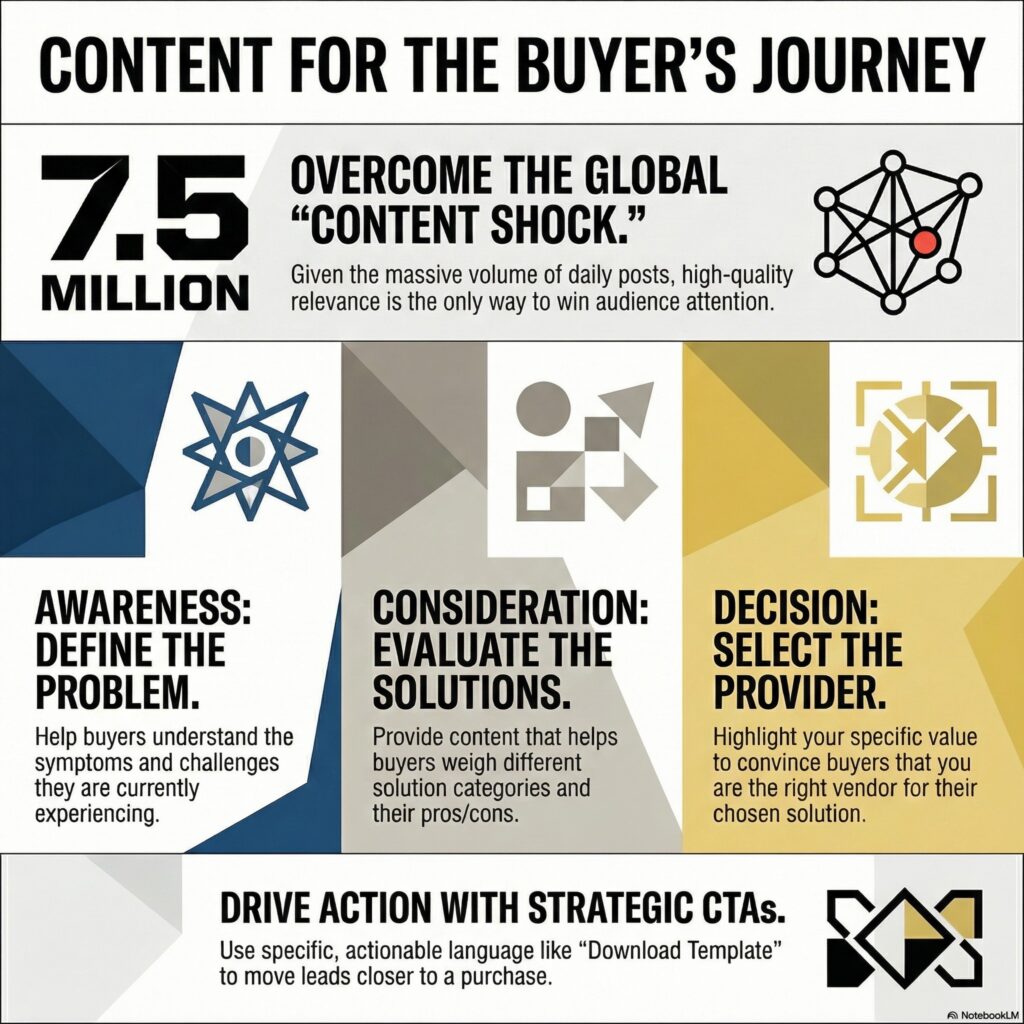
Welcome to today’s episode! This conversation generated by AI based on the transcript from HubSpot Academy titled “Creating Content for the Buyer’s Journey,” is structured around defining, strategizing, and executing a content plan tailored to the various stages of a customer’s path to purchase.
Main Structure
The document is organized into four primary sections:
- Defining the Buyer’s Journey: Establishing the foundational concept and its importance in inbound marketing.
- Identifying the Persona’s Path: Using research and interviews to map out specific experiences for target audiences.
- Brainstorming Content: A two-step process focusing first on the topic and then on the format for each stage.
- Driving Action and Frameworks: Implementing calls-to-action (CTAs) and building a sustainable content creation framework.
Key Points
- The Buyer’s Journey Stages: The journey consists of three critical stages:
- Awareness: The buyer experiences a problem and seeks to understand it.
- Consideration: The buyer defines their problem and researches different solutions.
- Decision: The buyer chooses a specific solution and vendor.
- The Importance of Personas: Marketers must focus on one buyer persona—a semi-fictional representation of an ideal customer—at a time to ensure the content narrative is accurate and relevant.
- Gathering Accurate Data: Rather than relying on assumptions, organizations should interview current customers, consult industry experts or sales teams, and conduct keyword research to understand the buyer’s true path.
- Topic Before Format: When brainstorming, the educational value (topic) must be identified before deciding on the presentation (format, such as a blog or video) to ensure the content truly addresses the buyer’s needs.
- Strategic CTAs: Every piece of content should include a call-to-action tailored to its format (written, visual, audio, or interactive) to guide the lead closer to a purchase without being obtrusive.
- The Content Creation Framework: To scale production, teams need a structured workflow that identifies specific steps (e.g., drafting, editing, designing) and assigns clear responsibilities for strategy, production, and distribution.
- Essential Tooling: A successful strategy requires three main types of tools: a content planning tool, a Content Management System (CMS), and an analytics tool to measure ROI and success.
Generated by AI